Nine Signs of Termites in a Townsville Home
There's a particular sound a Townsville homeowner learns to dread. It's the dull, papery thud a screwdriver handle makes against a skirting board that should be solid. If you've heard it, you already know the signs of termites are not always dramatic. Mostly they're quiet, easy to explain away, and discovered about eighteen months later than they should have been.
Townsville sits in one of the highest termite pressure zones in the country. The climate is warm year round, the soil holds moisture through the wet, and a good portion of the housing stock is timber sitting on stumps above a dark subfloor. CSIRO research puts termite activity in roughly one in three Australian homes, and the tropical north is comfortably above that average.
Here's what to look for, in the order you're most likely to find it.
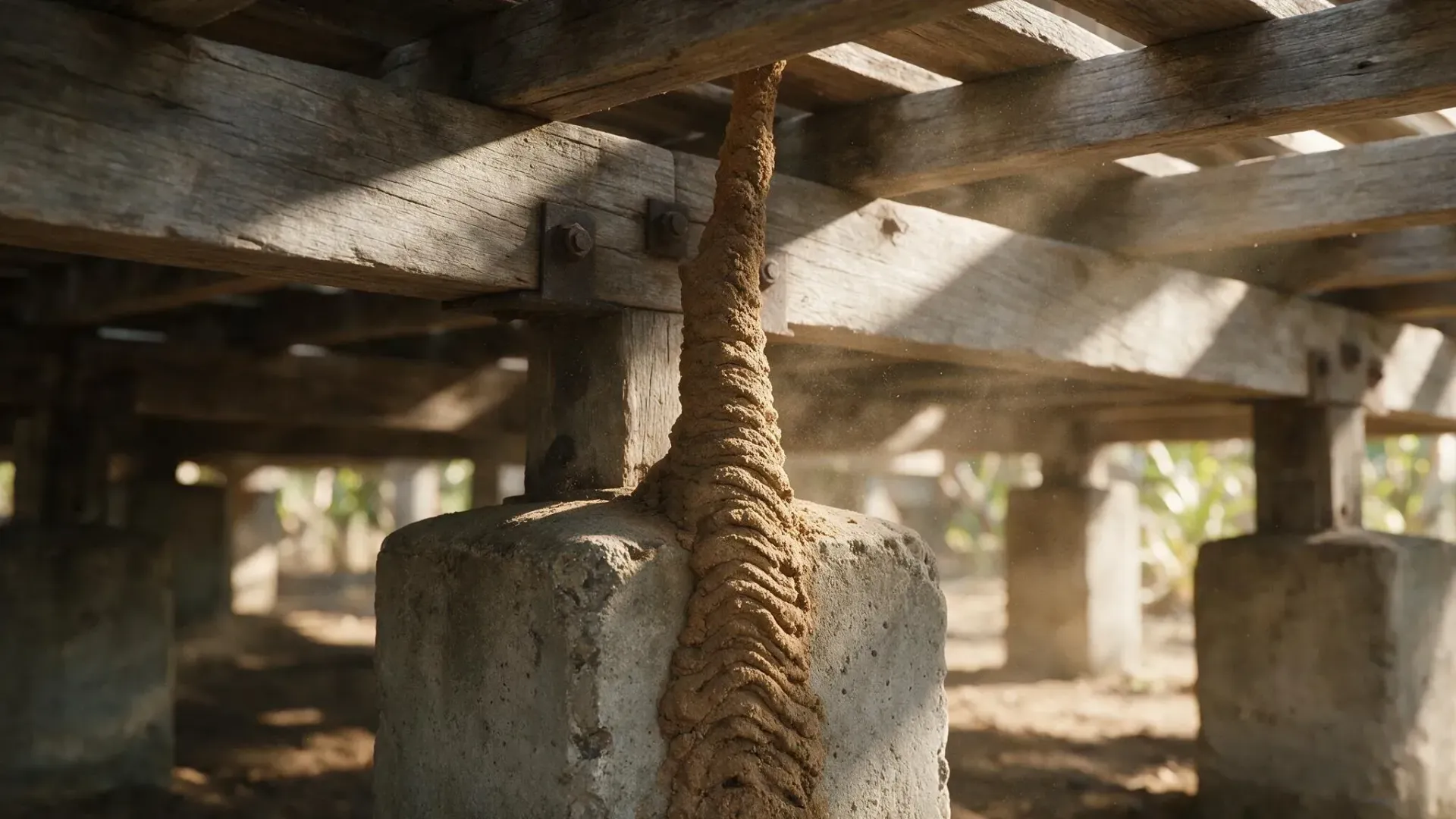
1. Mud tubes on piers, stumps and walls
Subterranean termites are blind, soft bodied and terrified of dry air. To get from soil to timber they build shelter tubes out of mud, saliva and their own droppings, usually about the width of a pencil, running vertically up concrete stumps, brick piers and foundation walls.
Look under the house first. Then check where garden beds meet external walls, behind downpipes, and along any retaining wall that touches the building. If you find one, resist the urge to break it open. More on why in a moment.
2. Timber that sounds hollow
Termites eat wood from the inside out, leaving a paper thin veneer of paint and surface timber intact. The room looks perfectly normal. Tap along skirting boards, architraves and door frames with the handle of a screwdriver and listen for the change in pitch.
Solid timber gives you a sharp, dense knock. Damaged timber gives you something closer to tapping a cardboard box. Work along a whole wall rather than testing one spot, because the contrast is what tells you something's wrong.
3. Bubbling, rippling or blistering paint
Paint that looks like it's lifting in small blisters is often mistaken for water damage, and in Townsville humidity that's a very reasonable assumption. It's also the reason this sign gets ignored constantly.
Termites bring moisture into the timber they're working. As they eat toward the surface, the paint film loses the substrate beneath it and starts to lift. If the blistering is on internal walls, low down, and there's no obvious plumbing above it, treat it as suspicious rather than cosmetic.
4. Discarded wings on windowsills
After a swarm, reproductive termites shed their wings and leave them in small translucent piles wherever they've landed. Windowsills, light fittings, laundry troughs and spider webs are the usual places you'll find them.
Wings inside the house mean a swarm happened inside the house. That's a different and more urgent situation than a swarm you watched circling the porch light from the back deck. Our guide to what discarded termite wings actually mean walks through how to tell termite wings from flying ant wings.
5. Frass and droppings
Drywood termites push their waste out of small kick holes, producing neat little mounds of granular pellets that look like coarse coffee grounds or fine sawdust. Subterranean species don't do this, so frass narrows down what you're dealing with as well as confirming that something is there.
Sweep it up and it'll be back within days. Take a photo before you clean it, because the colour and size of the pellets helps with identification.

6. Doors and windows that suddenly stick
Every Townsville home has a door that swells in the wet. That's normal. What isn't normal is a door that starts sticking outside the wet season, or one that goes from fine to jamming over a few weeks.
Termite activity introduces moisture and distorts frames as the timber behind them is consumed. If the sticking is confined to one door or one window while everything else in the house behaves, that's worth a closer look.
7. Clicking or rustling inside the walls
Soldier termites bang their heads against tunnel walls to signal danger to the colony. In a quiet house, late at night, with your ear against the wall, you can genuinely hear it. It sounds like faint dry rustling or a very soft, irregular clicking.
This one gets dismissed as imagination more than any other sign on the list. It usually isn't.
8. Sagging floors, ceilings and cornices
By the time a floor feels spongy underfoot or a ceiling sheet starts to bow, you're not looking at early signs of termites any more. You're looking at structural loss. Hairline cracking along cornices and faint brown staining on plasterboard often arrive first.
This is the stage where repair costs stop being measured in hundreds and start being measured in tens of thousands. Standard home insurance in Australia does not cover termite damage.
9. Damaged timber in the garden
Fence posts, retaining walls, old stumps, stacked firewood and landscaping sleepers are the termite equivalent of a service station on the highway. They're where a foraging colony stops before it finds your house.
Push a screwdriver into the base of a few fence posts. If it sinks in, you have active termites somewhere on the property, and the house is a matter of when rather than if. Read more on what termite mud tubes actually tell you if that is what you have found.
What each sign is actually telling you
| Sign | Likely stage | How urgent |
|---|---|---|
| Damaged garden timber | Foraging nearby | Book an inspection this month |
| Mud tubes on piers | Active entry attempt | Book an inspection this week |
| Discarded wings outside | Swarm season nearby | Book an inspection this month |
| Discarded wings inside | Colony in or under the house | Call now |
| Hollow timber | Established feeding | Call now |
| Bubbling paint | Feeding close to the surface | Call now |
| Sticking doors | Frame distortion underway | Call now |
| Sagging floors or ceilings | Structural damage | Call now, do not delay |
Why you shouldn't break open a mud tube
It's the most natural instinct in the world and it's the wrong move. Breaking a tube tells the colony it's been discovered. Termites will seal the breach, abandon that route and open another one somewhere you can't see.
You've also destroyed the evidence a technician needs to work out which species you have and where they're coming from. Photograph it, leave it alone, and let someone who does this for a living plan around it.
What happens next
If you've found one sign on this list, book a professional inspection. Australian Standard AS 3660.2 recommends inspections at intervals of no more than twelve months, and for high risk tropical areas like Townsville, six monthly is the sensible interval rather than the paranoid one.
An inspection at JJM covers the subfloor, internal timbers, the roof void, external surrounds and any outbuildings within thirty metres. We use thermal imaging and moisture meters, but the instruments support the inspection rather than replacing it. You get a written report you can actually act on. See termite inspections in Townsville for the detail.
Find something today? Call us on 07 4774 3316, or read about termite treatment that ends the colony. We're based in Garbutt and we've been doing this in Townsville for more than twenty years.
Frequently asked questions
How quickly can termites damage a Townsville home?
Faster than most people expect. A large Coptotermes colony can consume around 200 grams of timber a day, and significant structural damage can occur within three to six months of an infestation establishing. The giant northern termite, Mastotermes darwiniensis, is present across tropical north Queensland and is capable of doing severe damage to a house in about six months.
Does home insurance cover termite damage in Australia?
Almost never. Standard home and contents policies exclude damage caused by termites and other timber pests, on the basis that it's considered preventable through maintenance. This is why annual inspections are the only practical protection most homeowners have.
Are white ants and termites the same thing?
Yes. There's no such insect as a white ant. It's an old Australian colloquialism for termites, which aren't ants at all and are more closely related to cockroaches. The name matters because it leads people to buy ant products, which do nothing to a termite colony.
Can I treat termites myself if I find them early?
No, and attempting it usually makes the situation worse. Surface sprays kill the termites you can see and cause the colony to abandon that route and re-enter elsewhere, often somewhere concealed. Chemical termite treatment requires a licensed pest management technician in every Australian state.
How often should I get a termite inspection in Townsville?
AS 3660.2 sets twelve months as the maximum interval. In Townsville's climate, with year round termite activity and a large proportion of older timber housing, six monthly inspections are worth considering, particularly for homes on stumps, homes backing onto bushland, or homes with any previous termite history.