German Cockroaches and Why Sprays Do Not Work
Somewhere in the back of a Townsville kitchen cupboard is a can of surface spray that has been used weekly for four months. The cockroaches are still there. The homeowner has concluded that these particular cockroaches are unusually tough.
They're right, though not for the reason they think. German cockroaches beat supermarket sprays for three separate reasons, and each one is enough on its own.
First, make sure that's what you have
German cockroaches are small, 10 to 15 millimetres, light tan to brown, with two dark parallel stripes running down the pronotum, the shield behind the head. They have wings but they rarely fly.
They live indoors permanently. They do not come in from the garden, they do not go back out, and they will not leave when the weather changes. If you have them, they are breeding somewhere in your building.
The large reddish brown cockroaches that appear in Townsville laundries after rain are American cockroaches, a completely different proposition. Those are a nuisance. These are an infestation.
Reason one: the breeding maths
A female German cockroach carries her egg case, the ootheca, attached to her abdomen until roughly 24 hours before it hatches. Each case holds around 30 to 40 nymphs, and a female produces several across her life.
In warm conditions, which describes Townsville for twelve months of the year, a nymph reaches breeding age in as little as six weeks. Run that forward and a single gravid female introduced in a grocery box in October has produced a substantial population by Christmas.
Spraying kills adults on contact. It does almost nothing to egg cases, which are protected by a hard casing and are carried by the female into harbourage where the spray never reaches. Every treatment is therefore a treatment of the current generation only.
Reason two: insecticide resistance is real and documented
This is not a marketing line invented by pest controllers. Resistance in German cockroaches to pyrethroid insecticides, which is what almost every retail aerosol contains, is well documented internationally and is the reason professional treatment moved away from spraying decades ago.
The mechanism is straightforward selection. Spray a population, kill the susceptible individuals, and the survivors breed. Do it repeatedly and you have selected for a population that shrugs off the product. Given a six week generation time, that selection happens fast.
Some populations also develop behavioural resistance, including bait aversion to specific formulations, which is why professionals rotate active ingredients rather than using the same product indefinitely.
Reason three: spraying scatters the infestation
This is the one that actively makes things worse.
Most retail sprays are repellent by design. That's a selling point, since people want a product that keeps cockroaches away from a surface. Against a breeding indoor population it's a serious problem.
Cockroaches exposed to a repellent disperse away from it. They move deeper into wall cavities, into adjoining rooms, into the ceiling, and in a unit block, into the neighbouring apartment. You have taken a problem concentrated in one kitchen and distributed it through the building.
It also contaminates the bait. Gel bait placed in an area with repellent residue gets avoided entirely, which means the one thing that would work has been neutralised by the thing that doesn't.
What actually clears them
Professional German cockroach control runs on three components used together.
▪ Gel baiting into harbourage. Small precise placements into hinge recesses, kickboard voids, appliance housings and cavity edges. Cockroaches feed, return to harbourage, die there, and the active transfers to others through droppings, vomit and cannibalism.
▪ Insect growth regulators. These do not kill cockroaches. They prevent nymphs from developing into breeding adults, which collapses the population's ability to replace itself. This is what deals with the generation that hatches after treatment.
▪ Targeted residual and dust. Applied into voids, wall cavities and behind fixed cabinetry rather than sprayed across open surfaces.
The order matters. Bait and growth regulator do the work. Residual supports them. Nothing gets sprayed across the surfaces where the bait is placed.
Where they actually live in a kitchen
If you want to find them, look where it's warm, dark, tight and close to water.
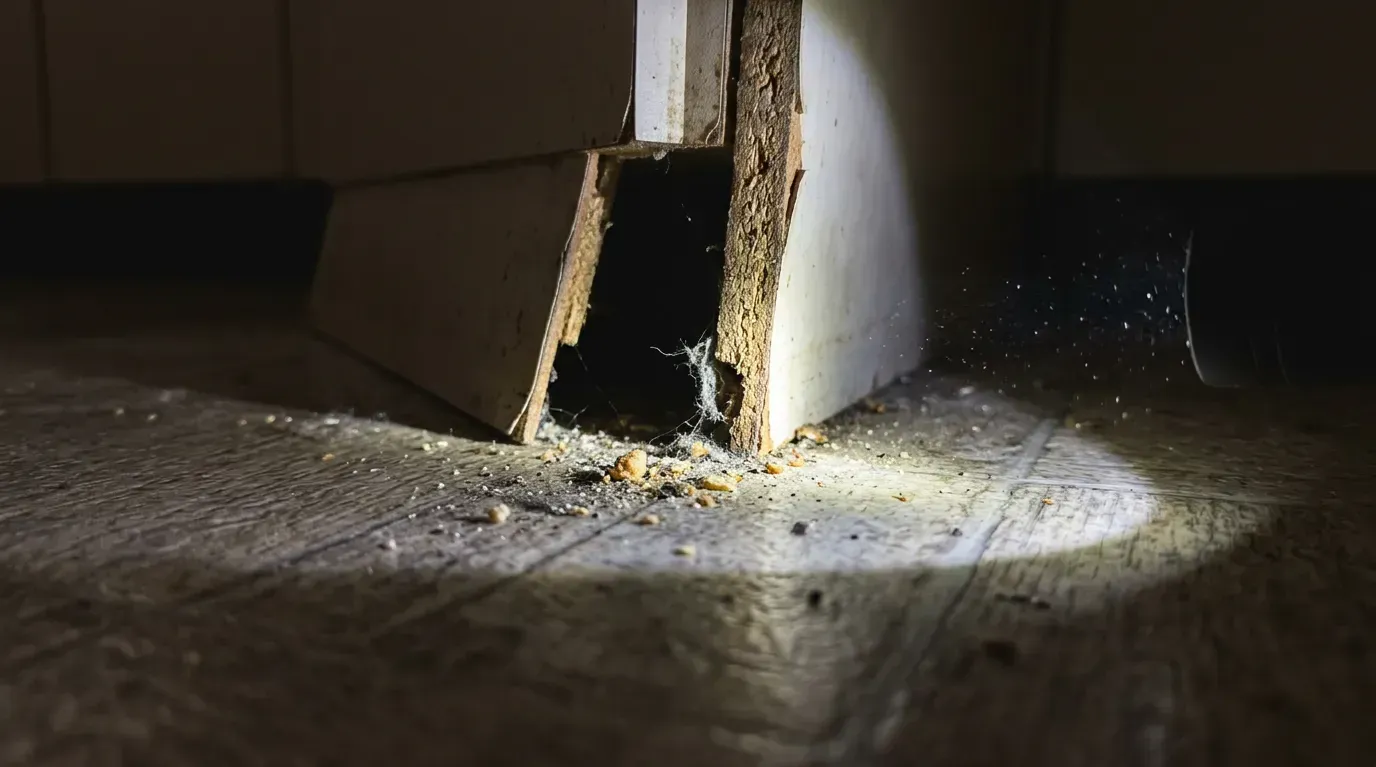
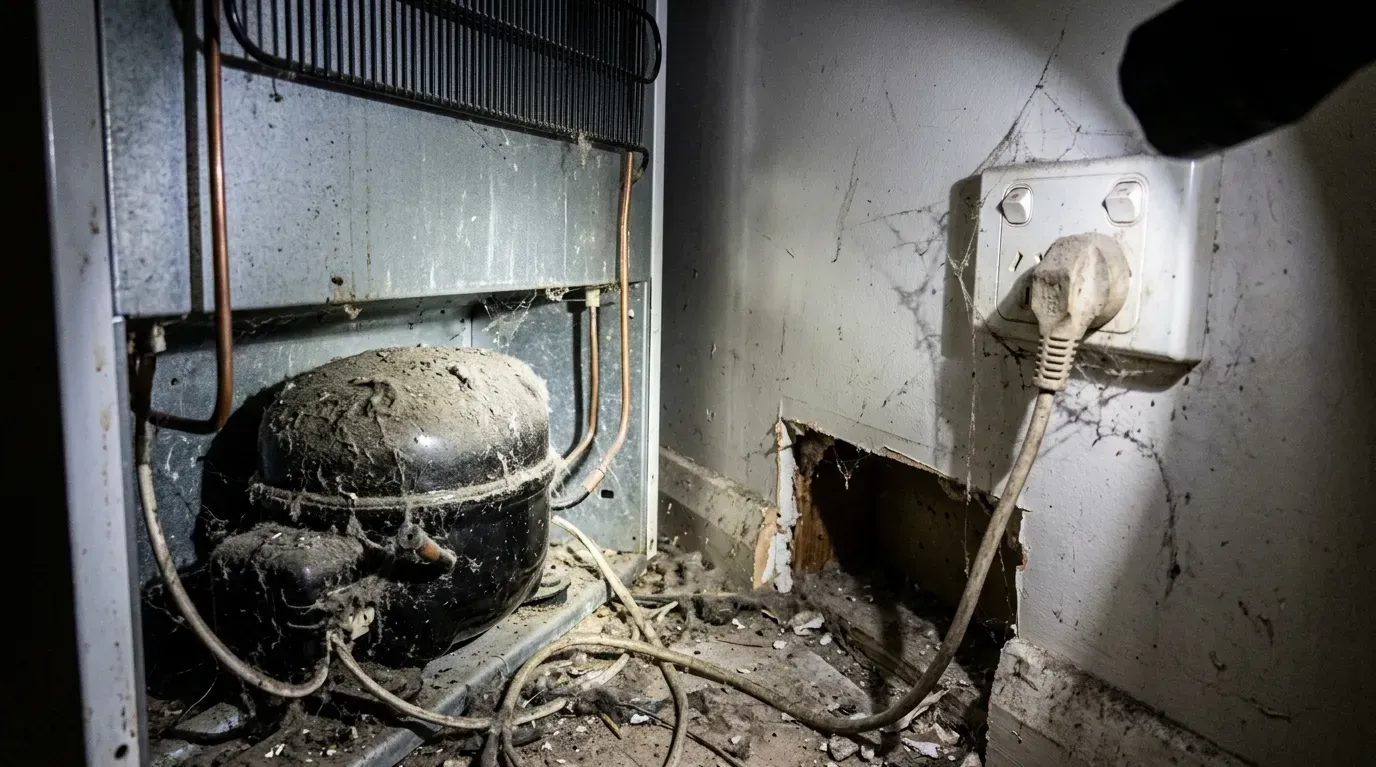
The refrigerator motor housing and the cavity behind it, which is the single most common harbourage in an Australian kitchen. The dishwasher housing and its insulation. Behind and under the microwave. Inside cupboard hinge recesses. The void behind the kickboard. Under the sink at pipe penetrations. Inside the coffee machine. Behind wall mounted ovens.
Our room by room plan for cockroaches in the kitchen works through each of those zones in order.
Units, townhouses and shared walls
If you live in a unit and you have German cockroaches, there is a real chance the source is not your apartment. They travel through shared wall cavities, along plumbing chases and via common service risers.
Treating one unit in a block with an established population is a temporary result. If you're in a body corporate, raise it, because a coordinated treatment across affected units is both cheaper and more effective than four residents each treating separately and reinfesting each other.
What to do now
Stop spraying. Give it a week so any repellent residue degrades. Then either bait properly yourself, following the placement approach in our guide to how to get rid of cockroaches properly, or call somebody.
For food premises the calculation is different and simpler. German cockroaches in a commercial kitchen are a compliance problem as well as a pest problem, and they need an ongoing programme rather than a treatment. See commercial pest control for food premises.
Call JJM Pest Management on 07 4774 3316, or see cockroach control in Townsville for the full residential service.
Frequently asked questions
How do German cockroaches get into a clean house?
They hitchhike. Grocery boxes and cartons, second hand appliances and furniture, delivery packaging, luggage, and shared wall cavities in units. Cleanliness affects how large a population can grow, not whether they arrive.
Is insecticide resistance in cockroaches actually proven?
Yes. Resistance to pyrethroid insecticides in German cockroach populations is well documented and is a recognised driver of the shift to gel baiting and growth regulators in professional pest management.
Why did the spray work at first and then stop?
Because it killed the susceptible individuals and the survivors bred. With a generation time of around six weeks in tropical conditions, a resistant population can establish within a single summer of repeated spraying.
Can I use spray and bait together?
Not in the same area. Repellent residue keeps cockroaches away from the bait, which neutralises the only product likely to work. If you have been spraying, stop and allow about a week before baiting.
How long does professional treatment take?
Expect a marked reduction within the first week and substantial control within two to three. A follow up at two to four weeks is standard, because egg cases are protected from treatment and hatch afterwards.