How to Get Rid of Cockroaches in a Tropical Home
There's a moment familiar to everyone who has lived in North Queensland. You get up for a glass of water at one in the morning, flick on the kitchen light, and something scatters. The question of how to get rid of cockroaches becomes urgent at approximately that instant.
The good news is that it's a solvable problem. The bad news is that almost everything sold to solve it is designed for the wrong species and the wrong climate.
Step one: work out which cockroach you have
This matters more than any product decision, because the two categories require completely different responses.
| What you're seeing | Species | What it means |
|---|---|---|
| Large, 30 to 40mm, reddish brown, usually one at a time | American cockroach | Came in from a drain, subfloor or roof void. Nuisance, not infestation. |
| Large, 30 to 35mm, dark with pale wing margins | Australian cockroach | Outdoor species from the garden or mulch. Low concern. |
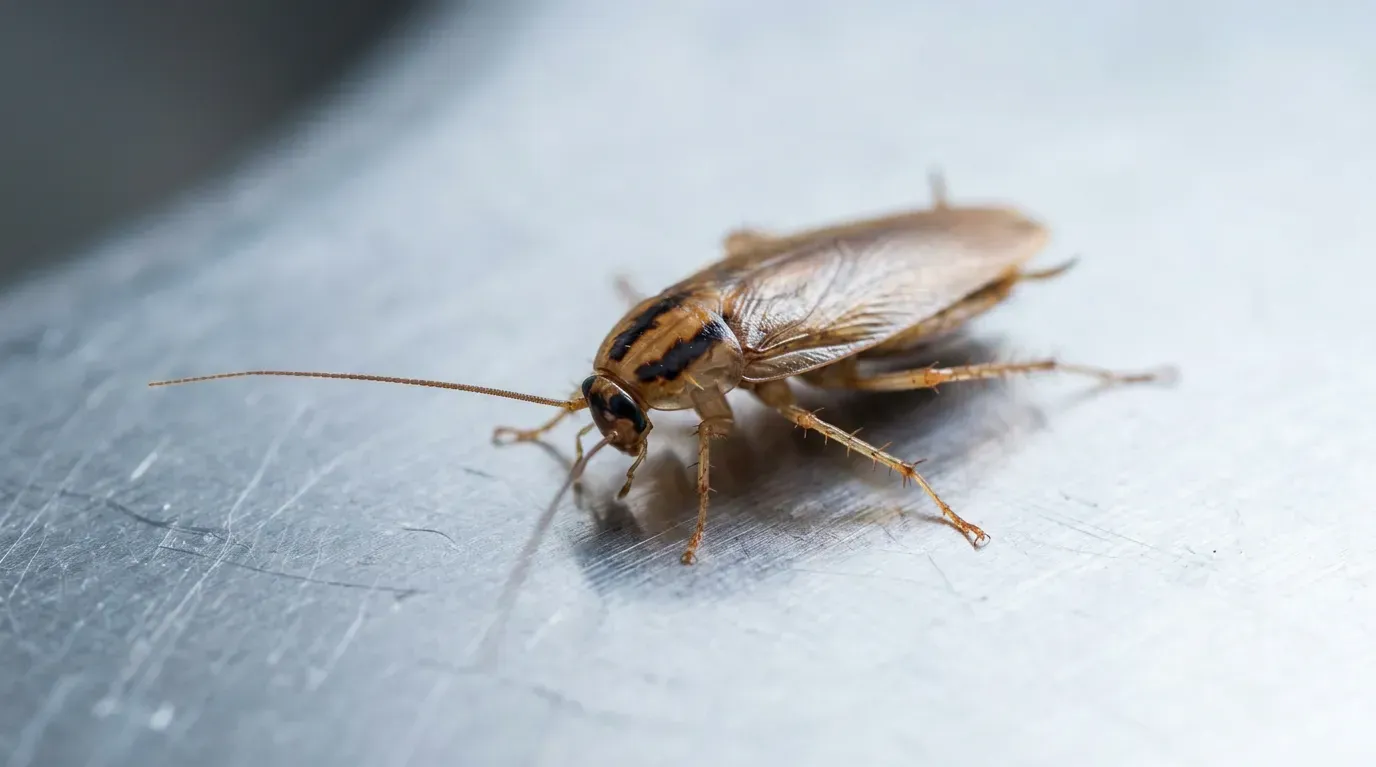
| Small, 10 to 15mm, tan, two dark stripes behind the head | German cockroach | Living and breeding indoors. This is a genuine infestation. |
| Small pale ones during the day | German cockroach, crowded harbourage | Large population. Act now. |
If you're seeing occasional big ones after rain, you have an entry problem. If you're seeing small striped ones near the kettle, you have a breeding problem, and those are not the same job.
Step two: find the harbourage, not the cockroach
Cockroaches spend roughly 75 per cent of their time hidden, pressed into tight gaps where their bodies contact surfaces on both sides. That behaviour, called thigmotaxis, is the single most useful thing to understand about them.
It means the cockroach you saw is not where the problem is. The problem is in the void behind the kickboard, the hinge recess in the cupboard, the motor housing of the fridge, the gap behind the dishwasher and the space under the sink.
Take a torch and look at those places at night. What you're counting is not cockroaches but evidence: dark specks of frass that look like ground pepper, shed skins, and the faint oily smell a large population produces.
Step three: cut off the water
Cockroaches can survive weeks without food. They cannot survive long without water, and in a Townsville home water is everywhere.
Fix the dripping tap under the vanity. Dry the sink and the shower recess before bed. Empty pet water bowls overnight, or move them. Check the fridge drip tray, the dishwasher seal, the washing machine outlet and the air conditioner condensate line. Clear the gutters, because standing water in a blocked gutter feeds a roof void population.
This single step does more than most people expect, and it costs nothing.
Step four: gel baiting, done properly
If you're going to buy one product, buy a cockroach gel bait. It's the only retail option that reliably works, and it works because of what happens after the cockroach eats it.
A cockroach that consumes gel bait returns to the harbourage and dies there. Other cockroaches feed on the carcass, the droppings and the vomit, and the active ingredient transfers through the population. This is called horizontal transfer and it's why bait reaches the ones you'll never see.
How to apply it: small beads, roughly the size of a match head, placed directly into harbourage rather than smeared on open surfaces. Inside cupboard hinges. Under the sink at the pipe penetration. Along the top edge of the kickboard. Behind and under the fridge. In the dishwasher and microwave housings. Twenty small placements beat two large ones every time.
What ruins it: spraying anything nearby. A repellent surface spray in the same room will keep cockroaches away from the bait entirely, which is the most common reason DIY baiting fails.
Step five: seal the entry points
For the large outdoor species, this is the whole job. Silicone around pipe penetrations under the sink and behind the toilet. Draught seals on external doors. Insect screens intact. Drain covers on floor wastes in laundries and bathrooms. Weep hole covers if your home has open weep holes at slab level.
A Townsville wet season pushes enormous numbers of outdoor cockroaches indoors over a few weeks. See cockroach-proofing before the wet season for the full checklist, since sealing before that happens is considerably easier than treating afterwards.
What bombs and foggers actually do
Very little, and often the opposite of what you want.
A fogger releases insecticide into open air. Cockroaches are in the voids, the cavities and the hinge recesses, where the fog does not reach. What it does reach is the surfaces you eat off, which then need cleaning.
Worse, most foggers use repellent actives. The cockroaches that survive disperse away from the treated area, which means a kitchen problem becomes a whole house problem and a unit problem becomes a neighbour's problem.
Why the tropics make it harder
German cockroaches complete a generation in as little as six weeks in warm conditions, and each egg case carries around 30 to 40 nymphs. In a climate with no winter, there is no seasonal reset. A population that would take two years to build in Hobart takes one summer here. See why German cockroaches beat supermarket sprays for what that means for treatment.
Humidity also helps them. Every gap that holds a bit of moisture becomes viable harbourage, and Townsville homes have a lot of gaps that hold moisture.
When to stop and call someone
Be honest with yourself about the point of diminishing returns. Call a professional if you're seeing German cockroaches during the day, if the population hasn't dropped after three weeks of proper baiting, if they're appearing in more than one room, if you're in a unit or townhouse where the source may be next door, or if you're running a food business, where the compliance stakes make DIY a poor risk.
Professional cockroach control in Townsville uses the same principles at a different scale: gel baiting into harbourage, insect growth regulators that stop nymphs reaching breeding age, and residual treatment to entry points and external harbourage. The advantage is knowing where to look and having products that aren't available retail.
Call JJM Pest Management on 07 4774 3316.
Frequently asked questions
How long does it take to get rid of cockroaches?
For occasional outdoor species entering the house, sealing entry points solves it immediately. For an established German cockroach infestation, expect two to three weeks for a marked reduction and four to six weeks for control, because egg cases are protected and hatch after the initial treatment.
Does keeping the house clean stop cockroaches?
It helps considerably but it does not guarantee anything. German cockroaches survive on crumbs measured in milligrams, and they enter clean homes in grocery boxes, appliances and second hand furniture. Cleanliness reduces the carrying capacity rather than eliminating the risk.
Why do I only see cockroaches at night?
They are nocturnal and strongly avoid light. Seeing them during the day usually means the harbourage is overcrowded and cockroaches are being displaced, which indicates a large population rather than a small one.
Are cockroaches dangerous?
They do not bite, but they walk through drains and waste and then across food preparation surfaces, and they can carry bacteria mechanically. Cockroach allergens are also a recognised asthma trigger, particularly in children, which is a stronger argument for control than the ick factor.
Will one treatment be enough?
For outdoor species entering the home, usually. For German cockroaches, a follow up at two to four weeks is standard and necessary, because it targets the generation that hatched after the first treatment.